Twinteraction, built at Dimensione3, turns 3D scans of real places into tours you walk through in the browser. On top of a Matterport scan it places 3D models, video, audio, tags, menus and quizzes. Editors build a tour; visitors play it. In a guided excursion, a guide moves through the space and every guest's camera follows.
I was its main engineer from 2023 to 2026. Most of my work was maintenance, optimisation and debugging, and I re-architected the tour engine into an engine core with feature plugins. One of the things I liked most was integrating our interactive tours with Moodle courses.
The hardest problem: a tour engine held together by globals
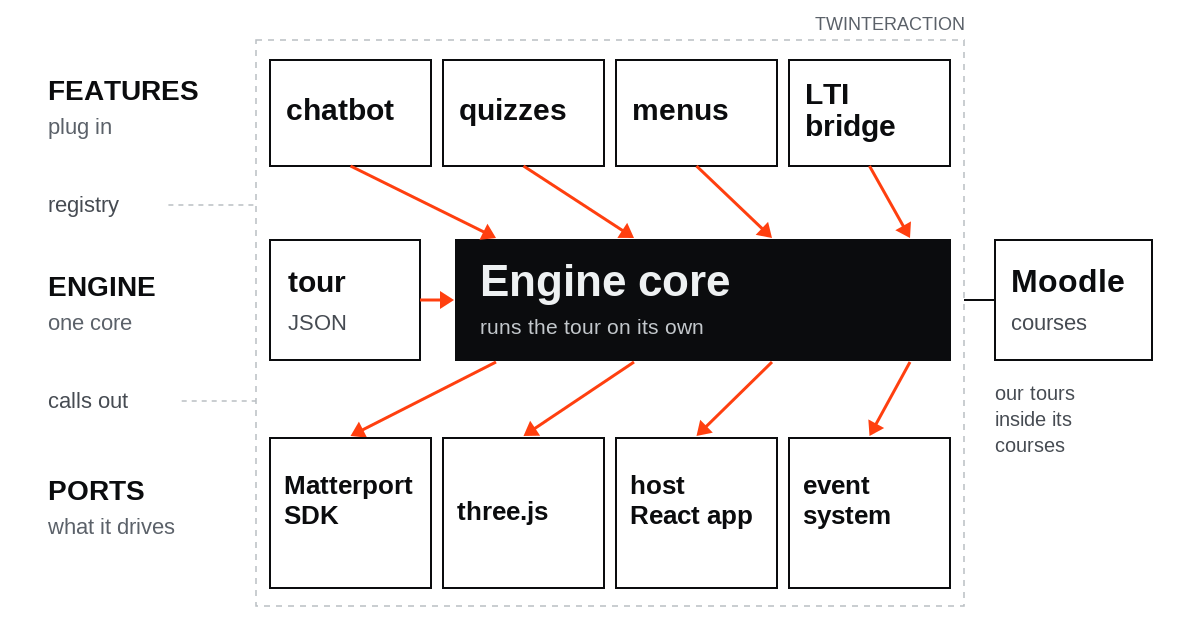
The engine is our own. It takes a tour defined in JSON, with everything we add on top of the Matterport scan, and runs it by itself. It reaches the outside through ports: into the Matterport SDK, three.js, the host React app and our own event system.
The code that runs a tour had grown since 2020, written by several teams. Services were global singletons reached from anywhere, much of the logic lived inside React components, and features were coupled to each other with no standard way to talk.
I took it apart in steps. First I moved the services out of the components and out of global scope, passed them in through constructors, and typed the data that had been untyped.
Then I wrote the design for a new architecture and built it. Every feature registers with a feature registry, and features talk only through it: commands for what one feature asks another to do, events for what has happened, and UI components that the registry renders into a single React root. Core features load first; plugin features are optional and switched on by configuration.
I did not rewrite it in one go. Old and new ran side by side, with adapters between them, and features moved over one at a time. New work went straight onto the new architecture: a chatbot that answers from a knowledge base kept per tour, quizzes, menus, a command palette, and a bridge to learning platforms over LTI that reads and posts scores.
Guided excursions
A guide's camera moves go to every guest over Socket.IO, and each guest queues them and replays them in order. Joining an excursion depended on a global reference to the 3D viewer that was not always ready. I moved the join and the camera listeners into the viewer's load callback, so they bind to the instance that has just loaded.
Loading, visibility and cost
Much of the debugging was tracking down costly behaviour that was hard to trace.
A tour is a scanned space split into rooms, and its models load in stages rather than all at once. I reworked the code that decides what loads next so it handles every layout of rooms, and put it under unit tests.
Whether a model should be visible depends on where the visitor stands, and on some loads a model showed where it should have been hidden. I moved that decision into one function, with tests for each case.
Some editor-only helpers were being created for every placed model, even though they stayed hidden, and together they cost a lot of CPU time. I took them out.
To check what a scene really holds, I added a button to the editor that exports the whole scene as glTF, the scan's mesh included at its current level of detail.
Tests
I set up unit tests with Vitest, ran them in CI, and later added integration and end-to-end tests.
Kubernetes
The app ran on a Kubernetes setup that was there before me. I ran it, and learned Kubernetes doing so.