Plain Engine is a game engine and a game I am writing by hand, to learn, not to ship. It follows Casey Muratori's Handmade Hero, with two changes: macOS and POSIX instead of Win32, and raylib only for the window, input polling and the GL context. The loop, timing, memory, assets and gameplay are written by hand. It is in progress.
I write every line that compiles. An AI model writes a short brief for each milestone and leaves scaffold comments in the source; I type the code, build and run after every step, and it reviews my diff for bugs that change behaviour. The build is a hand-written script with strict warnings on, and a compiler warning counts as a bug.
What works today
| Part | Status | Since |
|---|---|---|
| A hand-written build script, every warning on, a watcher that rebuilds on save | Works | 2026-10-31 |
Memory: one block from mmap, owned by the platform |
Works | 2026-10-31 |
| The game as a shared library, reloaded while it runs, keeping its state | Works | 2026-10-31 |
| A broken build keeps the old code running; a missing library is waited for | Works | 2026-10-31 |
| A backbuffer the engine owns, written by the game, drawn through raylib | Works | 2026-10-31 |
| Input: keyboard and gamepad, this frame beside the last | Next: brief written | |
| Looped editing: record input and replay it while the code reloads | Planned | |
| Time: a real clock and a held frame rate | Planned | |
| Sound | Planned | |
| Platform services: file I/O for the game, asserts, debug builds | Planned |
Hardware target. One machine, the one I write it on: a Mac with Apple silicon (arm64), macOS 15.6, Apple Clang 17. Nothing else is built or tested. There is no frame budget yet. The loop uses a fixed step of 1/60 s and sleeps 16 ms a frame, so the game's clock runs slower than a real one; a real clock is milestone 4.
The hardest part so far: reloading code without losing the game
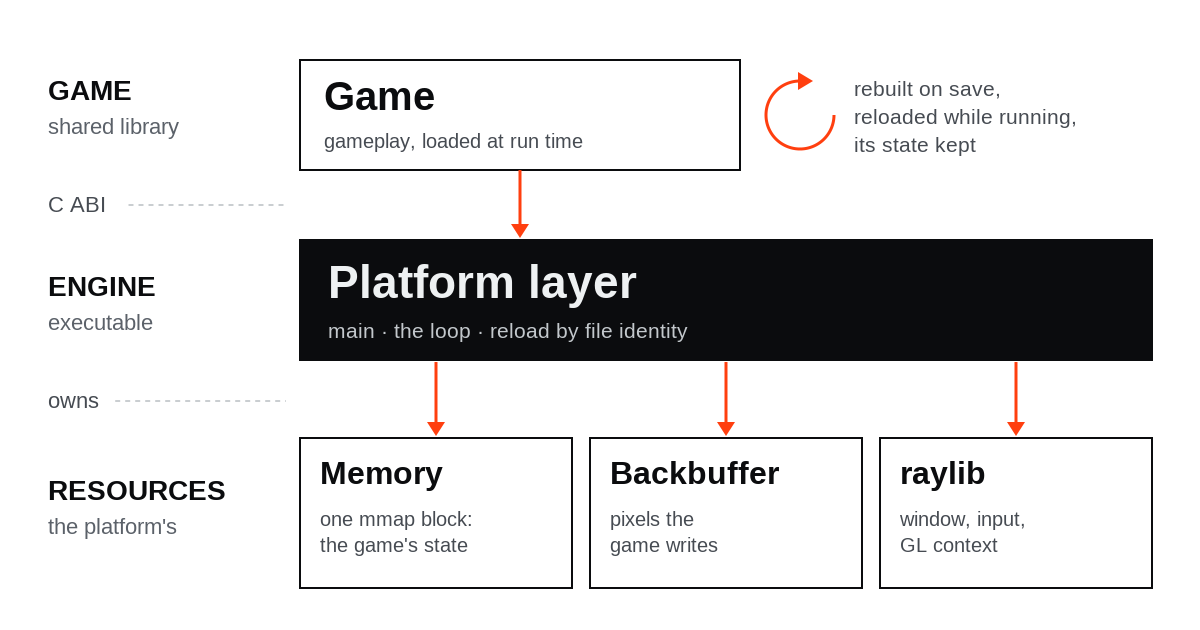
The engine is an executable. The game is a shared library the engine loads at runtime through a C ABI. When I save a change, the game reloads while it runs and keeps its state. Three things make that work.
- The platform owns the memory. The engine reserves one block with
mmapand hands the game a pointer to it. The game keeps its state there, because a global in the library does not survive a reload. - One signature, defined once. An early version cast the loaded symbol to a function type by hand. With every warning on, the compiler said nothing, and the program crashed: the cast lied about the function's signature. Now one macro defines the signature, and both sides use it.
- Reload by file identity. Handmade Hero copies the DLL before loading it, because
Windows locks a loaded DLL. macOS does not, and here the copy does harm:
cprewrites the same file in place, so the loader hands back the image it already has, with the old code. Apple's linker writes a new file and renames it into place, so loading the same path again gets the new code. The rule I took from it: port the reason, not the workaround.
The checks pass. State survives a reload, a broken build keeps the old code running, and the engine waits when the library is missing. A watcher in the build script rebuilds on save. When I added a field before an existing one, that field reset across the reload, which shows that the memory layout is the contract between the two sides.
Pixels
The engine owns a backbuffer. The game writes pixels into it, and the engine draws it through raylib each frame. The game draws a gradient, and a colour change shows up live across a reload. The game never includes raylib: that is the boundary.
Next
Input: keyboard and gamepad, with the previous frame kept beside the current one. Then Handmade Hero's looped editing: snapshot the game's memory, record input, and loop it while the code reloads. After that come time, sound and platform services.